

Metallographic Grinding and Polishing Machine
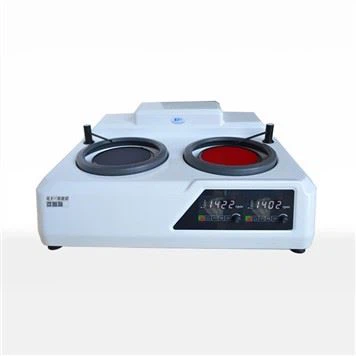
The Metallographic Grinding and Polishing Machine is a special equipment specially used for polishing and grinding metallographic samples. It is composed of a main engine and an auxiliary part, wherein the main engine comprises main components such as motor (reducer), main shaft, grinding head and grinding wheel, and auxiliary part comprises base, feeding hopper and discharge trough etc. The biggest feature of this equipment is that it can easily change a variety of grinding wheels of different specifications and sizes to meet different processing requirements.
Improve Efficiency
The Metallographic Grinding and Polishing Machine can quickly complete repetitive tasks such as grinding and polishing, greatly improving sample preparation efficiency.
High Precision
The grinding head, polishing head and other components of the Metallographic Grinding and Polishing Machine are precisely controlled to obtain a high-precision sample surface.
Easy To Operate
Metallographic Grinding and Polishing Machines usually adopt automated control. The operator only needs to set the parameters to automatically complete the sample preparation process.
Wide Scope Of Application
The Metallographic Grinding and Polishing Machine is suitable for metallographic sample preparation of various materials, such as metals, ceramics, glass, etc.
Reduce Labor Intensity
Using a Metallographic Grinding and Polishing Machine can reduce the labor intensity of manual sample preparation and reduce manual operation errors.
-
![M-1 Metallographic Pre-polishing Machine]() M-1 Metallographic Pre-polishing MachineP-2 Metallurgical Polishing MachineMain features : P-2 metallographic sample polishing machine was designed after collecting many customers' suggestions .P-2 operates steadily in low noise ,and...read more
M-1 Metallographic Pre-polishing MachineP-2 Metallurgical Polishing MachineMain features : P-2 metallographic sample polishing machine was designed after collecting many customers' suggestions .P-2 operates steadily in low noise ,and...read more -
![M-1 Type Single-disc Metallographic Pre-grinding Machine]() M-1 Type Single-disc Metallographic Pre-grinding MachineP-2 Metallurgical Polishing MachineMain features : P-2 metallographic sample polishing machine was designed after collecting many customers' suggestions .P-2 operates steadily in low noise ,and...read more
M-1 Type Single-disc Metallographic Pre-grinding MachineP-2 Metallurgical Polishing MachineMain features : P-2 metallographic sample polishing machine was designed after collecting many customers' suggestions .P-2 operates steadily in low noise ,and...read more -
![P-1 Type Metallographic Sample Polishing Machine]() P-1 Type Metallographic Sample Polishing MachineP-2 Metallurgical Polishing MachineMain features : P-2 metallographic sample polishing machine was designed after collecting many customers' suggestions .P-2 operates steadily in low noise ,and...read more
P-1 Type Metallographic Sample Polishing MachineP-2 Metallurgical Polishing MachineMain features : P-2 metallographic sample polishing machine was designed after collecting many customers' suggestions .P-2 operates steadily in low noise ,and...read more -
![P-2 Metallographic Specimen Polishing Machine]() P-2 Metallographic Specimen Polishing MachineP-2 Metallurgical Polishing MachineMain features : P-2 metallographic sample polishing machine was designed after collecting many customers' suggestions .P-2 operates steadily in low noise ,and...read more
P-2 Metallographic Specimen Polishing MachineP-2 Metallurgical Polishing MachineMain features : P-2 metallographic sample polishing machine was designed after collecting many customers' suggestions .P-2 operates steadily in low noise ,and...read more -
![MP-2 Metallographic Cutting Machine]() MP-2 Metallographic Cutting MachineMain features : MP-2 Grinding and Polishing Machine suitable for metallographic specimen pre-grinding,grinding and polishing operation, MP-2 Grinding and Polishing Machineis the necessary...read more
MP-2 Metallographic Cutting MachineMain features : MP-2 Grinding and Polishing Machine suitable for metallographic specimen pre-grinding,grinding and polishing operation, MP-2 Grinding and Polishing Machineis the necessary...read more -
![MPS-1B Type Metallographic Specimen Grinding And Polishing Machine]() MPS-1B Type Metallographic Specimen Grinding And Polishin...Main features: The metallographic sample grinding and polishing machine is a newly developed grinding and polishing machine with polishing function by our company in response to the current market...read more
MPS-1B Type Metallographic Specimen Grinding And Polishin...Main features: The metallographic sample grinding and polishing machine is a newly developed grinding and polishing machine with polishing function by our company in response to the current market...read more -
![M-2 Metallographic Sample Pre-grinding Machine]() M-2 Metallographic Sample Pre-grinding MachineM-2 metallographic sample pre-grinding machine Main F eature In the metallographic sample preparation process, the pre-grinding of the sample is an indispensable first step before polishing. After...read more
M-2 Metallographic Sample Pre-grinding MachineM-2 metallographic sample pre-grinding machine Main F eature In the metallographic sample preparation process, the pre-grinding of the sample is an indispensable first step before polishing. After...read more -
![MP-2 Single-disk Grinding And Polishing Machine]() MP-2 Single-disk Grinding And Polishing MachineMP-2 Metallographic Sample Grinding And Polishing Machine Main features : MP-2 Grinding and Polishing Machine suitable for metallographic specimen pre-grinding,grinding and polishing operation, is...read more
MP-2 Single-disk Grinding And Polishing MachineMP-2 Metallographic Sample Grinding And Polishing Machine Main features : MP-2 Grinding and Polishing Machine suitable for metallographic specimen pre-grinding,grinding and polishing operation, is...read more -
![MPS-1B Type Metallographic Sample Grinding And Polishing Machine]() MPS-1B Type Metallographic Sample Grinding And Polishing ...Metallographic sample grinding and polishing machine (variable speed) MPS-1B type Main features: The metallographic sample grinding and polishing machine is a newly developed grinding and...read more
MPS-1B Type Metallographic Sample Grinding And Polishing ...Metallographic sample grinding and polishing machine (variable speed) MPS-1B type Main features: The metallographic sample grinding and polishing machine is a newly developed grinding and...read more -
![P-1 Metallographic Specimen Polisher]() P-1 Metallographic Specimen PolisherP-1 Metallographic Specimen Polisher Main features : During metallographic sample preparation, polishing is primary .After polishing grinded samples , we can get very bright surface like mirror...read more
P-1 Metallographic Specimen PolisherP-1 Metallographic Specimen Polisher Main features : During metallographic sample preparation, polishing is primary .After polishing grinded samples , we can get very bright surface like mirror...read more -
![Single-disc Fully Automatic Grinding And Polishing Machine Model Mepao3]() Single-disc Fully Automatic Grinding And Polishing Machin...Main Features: The Mepao3 fully automatic grinding and polishing machine is a single-disc benchtop machine. It is a new generation of high-precision, fully automated sample preparation equipment...read more
Single-disc Fully Automatic Grinding And Polishing Machin...Main Features: The Mepao3 fully automatic grinding and polishing machine is a single-disc benchtop machine. It is a new generation of high-precision, fully automated sample preparation equipment...read more -
![Double-disc Fully Automatic Grinding And Polishing Machine Mepao-3S Model]() Double-disc Fully Automatic Grinding And Polishing Machin...Key Features: The MePao-3S automatic grinding and polishing machine features advanced sample preparation capabilities, ensuring consistency and reproducibility in sample preparation results....read more
Double-disc Fully Automatic Grinding And Polishing Machin...Key Features: The MePao-3S automatic grinding and polishing machine features advanced sample preparation capabilities, ensuring consistency and reproducibility in sample preparation results....read more


Why Choose Us
Experienced team
Our team of engineers and technicians has years of experience in the industry, and we leverage that expertise to provide our clients with the best possible solutions.
Exceptional customer service
We pride ourselves on providing exceptional customer service and technical support to our clients, ensuring that they have a smooth and hassle-free experience.
Competitive Price
We have professional sourcing team and cost accounting team, stive to reduce cost and profit and provide you a good price.
Quality Products
We use only the highest-grade materials and advanced manufacturing techniques to produce products that are reliable, durable, and perform to the highest standards.
Sustainable development
Establish a good reputation and brand value in the industry, and promote the sustainable, stable, rapid and healthy development of the enterprise.
One stop solution
From the begining inquiry and throughout the entire process until you receive the goods. We are dedicated to supporting you every step of the way.
Types of Metallographic Grinding and Polishing Machine
Single Disc Machines
These machines have one abrasive disc or polishing cloth and are suitable for small and simple samples.
Dual Disc Machines
These machines have two abrasive discs or polishing cloths and are suitable for larger and more complex samples.
Automatic Machines
These machines are fully automated and can perform all grinding and polishing steps automatically.
Manual Machines
These machines require manual operation and are suitable for small-scale use.
Do You Know the Basic Steps of the Grinding and Polishing Process
Grinding and polishing involve a gradual reduction in surface roughness to achieve an undeformed structure.
The process is based on the use of abrasive particles of progressively finer size. In metallographic grinding, these abrasives are bonded in a resin or metal matrix, and the most commonly used grinding abrasives are silicon carbide particles. These particles are typically used for processing soft, medium or hard materials, composites and electronics. Diamond particles can also be used on harder parts such as ceramics, carbides, glass or stone. The operator should always select a harder abrasive than the material being prepared.
The use of bonded abrasives produces high wear rates and is ideal for removing rust, surface deformation or material blocking areas of interest during cutting, and also allows for a high degree of flatness.
Metallographic grinding can be divided into surface grinding, fine grinding or super fine grinding, classified according to the size of the abrasive grains.
The polishing process involves loose abrasives rolling over the surface. This method is gentler and results in a better surface finish, but also has a lower removal rate. Metallographic polishing eliminates residual roughness from the grinding process, ensuring a good surface finish for further inspection.
The most common abrasives used in metallographic polishing and mechanical material removal are fine diamond particles (for pre-polishing or intermediate polishing) or oxides such as silica or aluminum oxide (for final polishing).
One significant difference between grinding and polishing is that it requires parameterization of the design program. Grinding procedures typically use a rotational speed of approximately 300 rpm, while polishing procedures will use approximately 150 rpm.
Another difference is that the direction of rotation may vary. Moving the sample holder in the opposite direction to the working wheel will result in higher removal rates, but also higher deformations.
In contrast, synchronized rotation (sample holder and work wheel move in the same direction) is less aggressive, resulting in lower removal rates but also less deformation.
Positioning the sample holder too close to the center of the wheel will cause the sample to extend beyond the edge of the wheel and result in poor grinding and polishing dynamics. Ideally, the sample holder should extend approximately 1 cm beyond the edge of the work wheel.
Most grinding and polishing machines allow force to be applied in center or single pressure modes. Center pressure mode applies force to the entire sample holder and any sample clamped within it. This option is ideal for large samples or individual shapes.
However, a single pressure mode cannot fix the sample. One or more samples are placed loosely in the holder and can move freely. The sample must have a round shape to benefit from this mode of operation. The force is applied directly through the pin.
Grinding and polishing machines require the operator to set the duration of each individual step for any automatic dosing system that may be used, including activating and setting dosing parameters.
Even when using grinding and polishing processes, samples should be cleaned between each step.
Application of Metallographic Grinding and Polishing Machine
Materials science
Researchers use metallographic grinding and polishing machines to prepare samples for examination and analysis.
Manufacturing
Metallographic grinding and polishing machines are used to prepare samples of manufactured products for quality control purposes.
Forensics
Metallographic grinding and polishing machines are used in forensic analysis to examine materials related to criminal investigations.
Components of Metallographic Grinding and Polishing Machine
Sand Disc Machine
Tray sanders use sanding discs that are secured to a backing plate with pressure-sensitive adhesive or clamping rings.
Belt Conveyor
Belt grinders and sanders consist of a driven contact pulley and a tensioned idler pulley or pulley. Abrasive belts are installed on both the contact wheel and the idler wheel. The work piece is ground or sanded on an abrasive belt. The contact wheel varies depending on the degree of aggressiveness or finishing required. The smooth, soft, variable speed polisher image rubber-faced contact wheel is minimally aggressive. The serrated, hard rubber-faced wheels are more aggressive. Smooth metal or steel faced wheels are the most aggressive.
Electrolytic Polishing And Etching Machine
Metallographic electropolishing machines use an electrochemical or electrolytic process after an abrasive grinding step to polish or refine the surface finish. Electrolysis polishes by attacking and dissolving the higher peaks on the sample surface. Electropolishing machines can also etch metallographic samples to expose grain boundaries, phases, or other metallographic features. Electrolytic polishing is suitable for metallographic polishing of austenitic stainless steel, pure aluminum, aluminum alloys, pure copper and copper alloys.
Grinder
A grinder produces a very flat surface (geometric refinement) and an extremely fine finish by using loose abrasives in a carrier fluid, where the part is machined between one or two large flat grinding plates or platens. Grinding removes much less material than grinding and honing. Surface treatments are measured in the micron and nanometer range.
Orbit/planet
Orbital or planetary metallographic preparation machines use orbital or planetary motion during the finishing or grinding process. Orbital action reduces the effects of any changes in the abrasive product or grinding surface.
Super Precision Machine
Superfinishing, microhoning or microfinishing machines produce surfaces with very fine or low average roughness (ra). Rub a piece of very fine gravel or several fine bonding stones on the surface of the workpiece. Superfinishing is similar to honing but produces a finer or lower ra finish through a limited amount of removal. Superfinishing cannot correct the geometry like honing can.
Variable Speed/multi-speed
Variable speed machines allow the motor speed to be adjusted. Variable speed adjustment allows continuous or discrete speeds within the operating range.
Vibration/oscillation Machine
Vibrogold cameras use vibration or oscillating motion during the finishing process.
The Grinding Material of the Metallographic Grinding and Polishing Machine
It is made by a special method, has low wear, saves attachments and is economical. In order to improve the elasticity and polishing effect, resin processing can be added. It is especially suitable for processing surface roughness of stainless
Steel, tin, aluminum, and other products. It is best used on automatic polishing machines with high working efficiency. In order to improve cutting force, resin processing can be added to the hemp wheel.
The high-density pure cotton raw materials are cut into 45-degree angles and punched by the machine to make them fine and wear-resistant. When the wave-shaped fan gaps are in contact with adjacent pages, they produce heat during high- speed rotation. The heat generated by the polishing is dissipated through the wave- shaped fan gaps, avoiding burning of the workpiece. With white wax or green wax, it can achieve a super mirror effect.
This product uses sword hemp and cotton cloth together to make it. It is suitable for deep processing and surface polishing of various coarse metal products such as steel, copper, and cast iron.
Using imported cloth as raw material and implementing automated production operations, the white cloth wheel produced is not only heat-resistant and durable compared to similar products, but also has a better brightness and smoothness when removing spiral lines.
The oil mill wheel is made of hemp as raw material, and is pressed by sword hemp and dried after soaking in tung oil. It is hard, sharp, and has strong cutting force. It is suitable for polishing stainless steel pipes, as well as stainless steel workpieces and alloy workpieces.
How to Maintain Metallographic Grinding and Polishing Machine
Regular Cleaning
Equipment should be cleaned after each use. First, clean the residual sample and abrasive in the equipment; then, wipe the outside of the equipment with a cleaning cloth, and clean the filter and drainage pipe regularly.
Lubricating Oil Addition
Regularly check the lubricating oil condition in the equipment. If the lubricating oil is found to be insufficient or dirty, add or replace new lubricating oil in time. When adding lubricating oil, be sure to follow the instructions in the equipment manual.
Replacement Of The Grinding Wheel
The grinding wheel is a key component of the equipment, and regular use will cause wear. When the grinding wheel is worn to a certain extent, a new grinding wheel should be replaced in time to ensure the normal grinding effect of the equipment.
Selection And Replacement Of Abrasives
Abrasives are important materials for grinding metallographic samples. Suitable abrasives should be selected according to the requirements of different samples. At the same time, check the use of the abrasive regularly. If the abrasive is found to have a long service life or is dirty, it should be replaced in time.
Operating Specifications
Operators should strictly follow the requirements in the equipment instructions and avoid overloading the equipment to avoid unnecessary damage. Pay attention to safety when operating equipment and wear protective gloves and goggles to prevent accidents.
Regular Maintenance
Perform regular maintenance on the equipment, such as checking whether the wires are aging and whether the fastening screws are loose, etc. To ensure that all parts of the equipment are normal.
Process of Metallographic Grinding and Polishing Machine
In the process of metallographic sample preparation, the polishing and polishing of the sample is two very important processes, usually the metallographic sample pre-grinding machine and the metallographic sample polishing machine two kinds of equipment to complete, in order to meet the needs of China's industrial and scientific and technological development, combined with the user's requirements, our company newly designed and manufactured into a metallographic sample grinding and polishing machine. Using frequency conversion stepless speed regulating motor, the appearance of the machine is novel and beautiful, the appearance is novel and beautiful, durable, maintenance is also very convenient, only need to replace the grinding disc or throwing disc when using, you can complete the rough grinding, fine grinding, dry grinding, wet grinding and polishing of various samples, in order to expand the preparation of different samples, can increase the effective working surface by 20-30%, can improve the grinding and polishing quality of the sample and the preparation efficiency of the sample, and the machine rotates smoothly, low noise, is a very ideal and functional metallographic sample preparation equipment. Using frequency conversion stepless speed regulating motor, the machine is novel and beautiful in appearance, novel and beautiful in appearance, durable, and extremely convenient for maintenance, only need to replace the grinding disc or throwing disc when using, and can complete the rough grinding, fine grinding, dry grinding, wet grinding and polishing of various samples.
Precautions for Using a Metallographic Grinding and Polishing Machine
Read and understand all rules of use.Remember common sense when using electrical appliances.Follow all warnings and rules marked on the product and in the documentation provided with the product.If there is a conflict between usage rules and safety information, obey the safety information. If you cannot resolve the conflict, please ask the seller or service agency for help.When cleaning the outside of the machine, please unplug the power plug. Do not use cleaning fluid or kerosene. Only use a damp cloth to clean the machine.Do not place the device on an unstable surface. Otherwise, the device may fall and cause serious damage.No items are allowed to be placed on power supplies or grinding and polishing machines.Do not overload wall power strips as this may result in fire or electric shock.To avoid the risk of electric shock, do not disassemble the grinder and polisher. If repairs are required, ask a qualified service technician to do so. Opening or removing covers can expose you to dangerous voltages or other hazards, and incorrect reassembly can result in electric shock during subsequent use.
Unplug the plug from the wall and have it serviced by a qualified service technician under the following conditions:
The power cord, plug or connecting cable is damaged or frayed.Operate the grinding and polishing machine according to the rules, but the machine does not work.The grinding and polishing machine fell or the casing was damaged.There are sudden and noticeable changes in the performance of the grinding and polishing machine.Only parts mentioned in the operating instructions are allowed to be adjusted.Keep this manual.
Our Factroy
Laizhou lailuote testing instrument Co.,ltd. specializes in researching&developing, manufacturing hardness testers and metallographic preparation instruments. Our products are Widely used in quality control, college, laboratories and industries. Founded in 2007, Located in the "base of china hardness testers" -Laizhou city, Lailuote is today one of China's leading manufacturers of hardness testers and metallographic preparation products. Over the years we have built a professional team of engineers, scientists, marketing sales and customer services, in which many people has more than 40 years experience in this field.

FAQ
We're professional metallographic grinding and polishing machine manufacturers and suppliers in China, specialized in providing high quality products. We warmly welcome you to wholesale bulk metallographic grinding and polishing machine from our factory. For price consultation, contact us.
troubleshooting metallographic polishing machine, Grinder Polisher Machine, Metallographic Sample Grinding And Polishing Machine