

What is the measuring speed of a bench top hardness tester? Well, let's dig into this topic right away. As a bench top hardness tester supplier, I've had my fair share of experiences with these nifty machines, and I'm excited to share all about their measuring speed.
First off, what's a bench top hardness tester? It's a device used to measure the hardness of materials. You place a sample on the testing platform, and the machine applies a specific force through an indenter. The depth of the indentation left on the material's surface is then measured, and this measurement is used to determine the hardness of the material. There are different types of bench top hardness testers, like the Manual Rockwell Hardness Tester HR150A, which is a popular choice for many users.
Now, onto the measuring speed. The measuring speed of a bench top hardness tester can vary depending on several factors. One of the main factors is the type of hardness testing method it uses. There are a few common methods, such as Rockwell, Brinell, and Vickers.
Let's start with the Rockwell method. The Manual Rockwell Hardness Tester HR150A operates based on this method. In the Rockwell test, a minor load is first applied to seat the indenter, and then a major load is added. After a specified time, the major load is removed, and the hardness value is read from the scale. The measuring speed of a Rockwell hardness tester is relatively fast. It usually takes only a few seconds to apply the loads and read the hardness value. For example, in a production environment where you need to test a large number of samples quickly, a Rockwell tester can be a great choice. You can test a sample in as little as 10 - 15 seconds, depending on how experienced the operator is and how quickly the sample can be positioned.
The Brinell method, on the other hand, is a bit slower. In a Brinell test, a hard steel or carbide ball is pressed into the material under a specific load for a defined period, usually 10 - 30 seconds. After the load is removed, the diameter of the indentation is measured using a microscope. Measuring the diameter accurately can take some time, especially if the indentation is small. So, overall, a Brinell hardness test can take anywhere from 30 seconds to a couple of minutes per sample. This method is often used for testing softer materials or materials with a coarse grain structure.
The Vickers method is also relatively slower compared to the Rockwell method. In a Vickers test, a diamond pyramid indenter is used, and the load is applied for a certain time. After that, the two diagonals of the square - shaped indentation are measured under a microscope. Measuring the diagonals precisely can be time - consuming, and a Vickers test can take around 30 seconds to a minute or more per sample. However, the Vickers method is very accurate and can be used for a wide range of materials, including very hard and very soft ones.

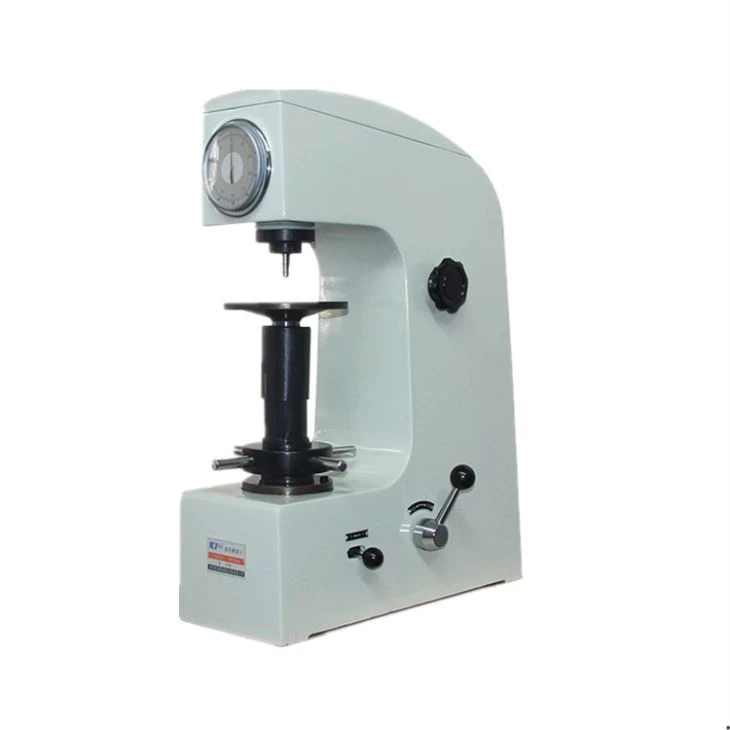
Another factor that affects the measuring speed is the automation level of the bench top hardness tester. Automated testers are generally faster than manual ones. With an automated tester, the sample positioning, load application, and measurement reading can be done automatically. For example, some of our Wholesale Hardness Testers For Stainless Steel come with advanced automation features. These testers can be programmed to test multiple samples in a sequence, and they can adjust the testing parameters automatically based on the material type. This can significantly reduce the testing time per sample. An automated Rockwell tester can test a sample in as little as 5 - 10 seconds, which is much faster than a manual tester.
The operator's skill level also plays a role in the measuring speed. An experienced operator who is familiar with the machine's operation can perform the tests more quickly. They know how to position the sample correctly, how to apply the loads smoothly, and how to read the results accurately. For a novice operator, it might take a bit longer to get the hang of it, but with practice, they can also improve their testing speed.
The measuring speed of a bench top hardness tester is an important consideration, especially for industries where time is of the essence. In the manufacturing industry, for example, if you're producing thousands of parts every day, a faster testing speed can increase your production efficiency. You can get the hardness test results more quickly and make decisions about the quality of the parts in a timely manner.
At our company, we offer a wide range of Hardness Testing Machine with different measuring speeds to meet the diverse needs of our customers. Whether you need a fast - testing Rockwell tester for high - volume production or a more accurate but slightly slower Vickers tester for research and development, we've got you covered.
If you're in the market for a bench top hardness tester and want to know more about the measuring speed or other features of our products, feel free to reach out to us. We're here to help you choose the right tester for your specific requirements. Contact us for more information and let's start a conversation about how we can assist you in your hardness testing needs.
References
- "Materials Testing Handbook" - A comprehensive guide on different materials testing methods, including hardness testing.
- Industry reports on the latest advancements in bench top hardness testing technology.