

Hey there! As a supplier of Webster Hardness Testers, I'm stoked to share with you all the amazing advantages these nifty tools bring to the table. Let's dive right in!
1. Portability and Ease of Use
One of the biggest perks of a Webster Hardness Tester is its portability. Unlike some large - scale hardness testing equipment that's stuck in a lab, a Webster Hardness Tester is small and lightweight. You can easily carry it around in your toolbox or even in your pocket. Whether you're on a construction site, in a manufacturing plant, or out in the field doing quality checks, you can take your Webster Hardness Tester with you.

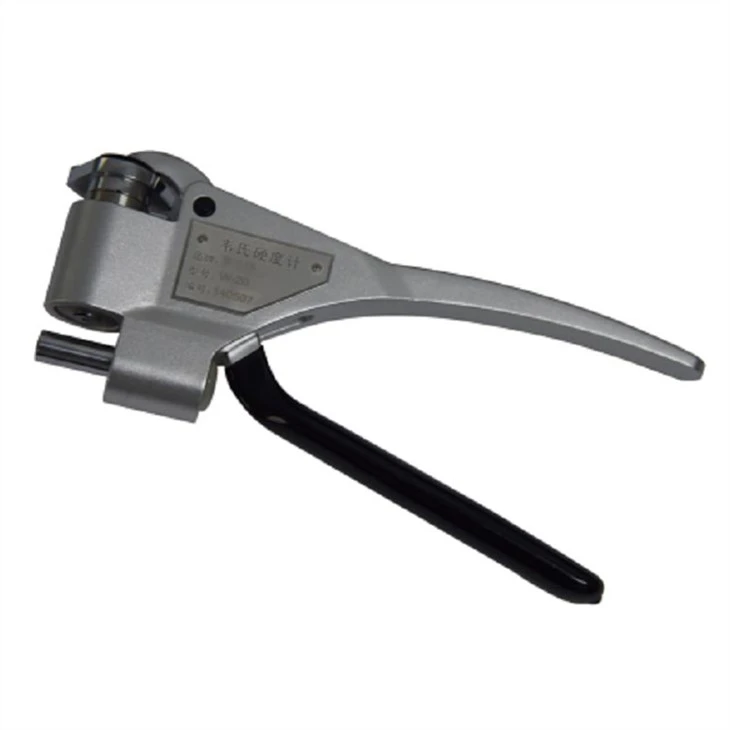
It's also incredibly easy to use. You don't need to be a rocket scientist to operate it. All you have to do is place the tester on the material you want to test, apply a little pressure, and read the hardness value on the scale. There's no need for complex set - up procedures or long training sessions. This simplicity means that even non - technical staff can quickly learn to use it, saving time and money on training.
2. Quick Results
In today's fast - paced world, time is money. The Webster Hardness Tester delivers results in a flash. You can get an accurate hardness reading in just a few seconds. This is a huge advantage when you're dealing with high - volume production lines. Instead of waiting for hours or even days to get results from a lab test, you can make immediate decisions about the quality of your materials.
For example, in an aluminum extrusion factory, workers can quickly test the hardness of each extrusion as it comes off the line. If the hardness is not within the specified range, they can take immediate corrective action, such as adjusting the production process. This real - time feedback helps to improve product quality and reduce waste.
3. Non - Destructive Testing
Another great advantage is that the Webster Hardness Tester performs non - destructive testing. When you test a material with this tester, you don't damage it. This is crucial in many industries where the tested parts need to be used in the final product.
For instance, in the aerospace industry, components are extremely expensive and need to meet strict quality standards. Using a Webster Hardness Tester, engineers can test the hardness of critical parts without compromising their integrity. This means that the tested parts can still be used in the aircraft, saving a significant amount of money.
4. Wide Range of Applications
The Webster Hardness Tester is versatile and can be used to test a wide range of materials. It's particularly well - known for testing the hardness of aluminum alloys, which are widely used in industries such as construction, automotive, and aerospace. But it can also be used to test other non - ferrous metals and some plastics.
This wide range of applications makes it a valuable tool for many different types of businesses. Whether you're a small metal fabrication shop or a large multinational corporation, a Webster Hardness Tester can be a great addition to your quality control arsenal. You can check out the Webster Hardness Tester W - 20 on our website for a specific model that offers great performance across these various applications.
5. Cost - Effective
When it comes to quality control tools, cost is always a consideration. The Webster Hardness Tester is a very cost - effective option. It's relatively inexpensive compared to other types of hardness testing equipment, especially when you consider its portability, ease of use, and quick results.
In addition to the initial purchase cost, the maintenance cost of a Webster Hardness Tester is also low. It doesn't require expensive calibration equipment or frequent servicing. You can easily perform basic maintenance tasks yourself, such as cleaning the indenter and checking the spring tension. This makes it a great choice for businesses of all sizes, especially small and medium - sized enterprises that are looking to keep their costs down.
6. Reliable and Accurate
Accuracy is key when it comes to hardness testing. The Webster Hardness Tester is known for its reliability and accuracy. It uses a well - established testing principle and has been refined over the years to provide consistent results.
The scale on the tester is clearly marked, and the readings are easy to understand. The indenter is designed to make a precise indentation on the material, which allows for an accurate measurement of the hardness. This reliability means that you can trust the results you get from the tester, whether you're using it for quality control or research purposes.
7. Compatibility with Industry Standards
The Webster Hardness Tester is designed to be compatible with industry standards. This is important because it ensures that the hardness values you obtain are comparable to those obtained by other testing methods and equipment.
In the aluminum industry, for example, the hardness values measured by a Webster Hardness Tester can be correlated with the values obtained by other standard hardness testing methods, such as the Brinell or Rockwell tests. This compatibility makes it easier for businesses to meet regulatory requirements and to communicate their quality control data to customers and partners. You can also explore our Wechsler Hardness Tester which adheres to these high - standard compatibility requirements.
8. Durability
These testers are built to last. They are made from high - quality materials that can withstand the rigors of daily use in industrial environments. The housing is usually made of a tough plastic or metal alloy, which protects the internal components from damage.
The indenter, which is the most critical part of the tester, is made of a hard - wearing material. It can withstand repeated use without losing its sharpness or accuracy. This durability means that you can rely on your Webster Hardness Tester for years to come, making it a long - term investment for your business.
Why You Should Consider Buying from Us
As a supplier of Webster Hardness Testers, we offer more than just the product. We provide excellent customer service, including technical support and training. Our team of experts is always ready to answer your questions and help you get the most out of your tester.
We also offer a wide range of models to suit different needs and budgets. Whether you need a basic tester for occasional use or a more advanced model for high - volume production, we've got you covered. And we ensure that all our products are of the highest quality, so you can be confident in your purchase.
If you're in the market for a Webster Hardness Tester, we'd love to hear from you. Contact us today to discuss your requirements and start a procurement conversation. We're here to help you make the right choice for your business and ensure that you get the best value for your money.
References
- "Hardness Testing Handbook" by ASTM International
- "Metals Handbook: Properties and Selection: Nonferrous Alloys and Pure Metals" edited by ASM International