

Hey there, folks! I'm a supplier of Leeb Hardness Testers, and today I'm gonna share with you how to use a Leeb Hardness Tester for hardness testing of nanomaterials. Nanomaterials are all the rage these days, with their unique properties and potential applications in various fields. But testing their hardness can be a bit tricky. That's where our Leeb Hardness Testers come in handy.
Understanding Nanomaterials and Hardness Testing
First off, let's talk a bit about nanomaterials. Nanomaterials are materials with at least one dimension in the nanoscale range (usually between 1 and 100 nanometers). They can have different structures, such as nanoparticles, nanowires, or thin films. Due to their small size, nanomaterials often exhibit different mechanical properties compared to their bulk counterparts.
Hardness is an important mechanical property that measures a material's resistance to indentation or scratching. For nanomaterials, hardness testing is crucial to understand their performance and durability. There are several methods for hardness testing, but the Leeb hardness testing method is quite popular because it's fast, non - destructive, and can be used on a variety of materials.
How a Leeb Hardness Tester Works
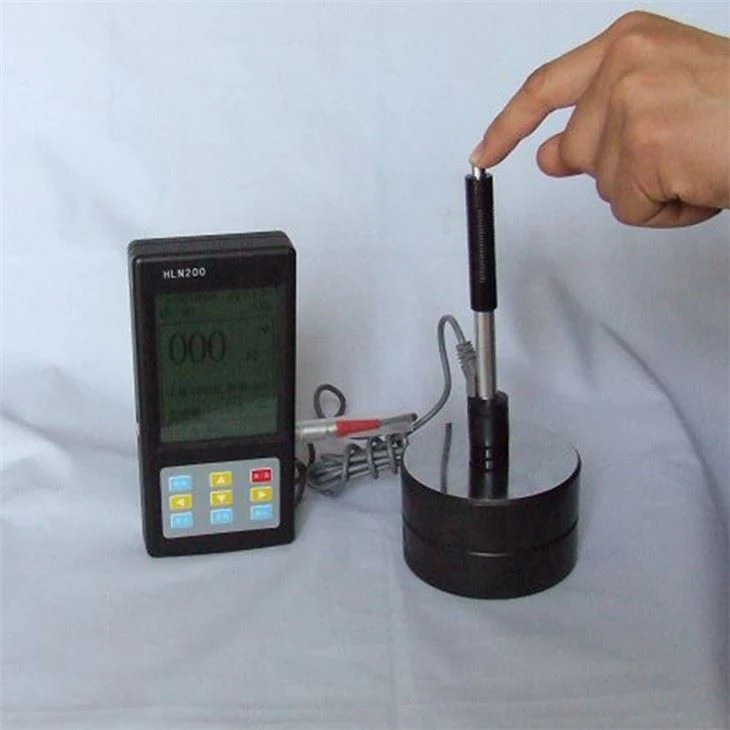
A Leeb Hardness Tester works based on the principle of dynamic indentation. It consists of a test body and a probe. When the probe hits the surface of the material, it rebounds. The ratio of the impact velocity to the rebound velocity is measured, and this ratio is then used to calculate the hardness value.
The formula for calculating Leeb hardness (HL) is based on the kinetic energy of the impact and rebound. The tester measures the velocities of the impact body before and after hitting the material surface. The higher the rebound velocity relative to the impact velocity, the harder the material.
Preparing for the Test
Before you start testing the hardness of nanomaterials with a Leeb Hardness Tester, there are a few things you need to do.
Sample Preparation
The surface of the nanomaterial sample needs to be clean and smooth. Any dirt, oil, or rough spots on the surface can affect the test results. You can use a gentle cleaning agent and a soft cloth to clean the sample surface. Also, make sure the sample is properly fixed or supported so that it doesn't move during the test.
Tester Calibration
It's essential to calibrate the Leeb Hardness Tester before each use. Calibration ensures that the tester is giving accurate results. You can use a standard reference block with a known hardness value to calibrate the tester. Follow the manufacturer's instructions for calibration, which usually involves hitting the reference block a few times and adjusting the tester settings if necessary.
Conducting the Hardness Test
Once you've prepared the sample and calibrated the tester, it's time to conduct the test.
Selecting the Right Probe
Leeb Hardness Testers come with different types of probes. For nanomaterials, you need to choose a probe that is suitable for the material's properties and the test requirements. Some probes are designed for softer materials, while others are better for harder materials. Make sure to select the probe that gives the most accurate results for your nanomaterial sample.
Test Procedure
- Hold the tester firmly against the sample surface. Make sure the probe is perpendicular to the surface.
- Press the trigger to release the impact body. The tester will measure the impact and rebound velocities and calculate the hardness value.
- Take multiple measurements at different locations on the sample surface. This helps to get a more accurate average hardness value. Usually, taking 5 - 10 measurements is a good practice.
- Record the hardness values for each measurement. You can use the tester's built - in memory to store the data or write it down manually.
Analyzing the Test Results
After you've taken all the measurements, it's time to analyze the results.
Calculating the Average Hardness
Calculate the average of all the hardness values you've recorded. This gives you a more representative hardness value for the nanomaterial sample. You can use a simple calculator or a spreadsheet program to do the calculation.

Comparing with Standards
Compare the average hardness value with the relevant industry standards or the expected hardness range for the nanomaterial. If the measured hardness is significantly different from the expected value, it could indicate issues with the material's quality or manufacturing process.
Advantages of Using a Leeb Hardness Tester for Nanomaterials
There are several advantages of using a Leeb Hardness Tester for hardness testing of nanomaterials.
Non - Destructive Testing
One of the biggest advantages is that it's a non - destructive testing method. This means you can test the nanomaterial without damaging it, which is especially important for expensive or rare nanomaterials.
Fast and Easy
Leeb hardness testing is fast and easy to perform. You can get the hardness results in a matter of seconds, which is much quicker compared to some other hardness testing methods.
Versatility
Leeb Hardness Testers can be used on a wide range of materials, including different types of nanomaterials. Whether it's a metal - based nanomaterial or a polymer - based one, the tester can provide accurate hardness measurements.
Our Leeb Hardness Tester Products
We offer a variety of Leeb Hardness Testers to meet different testing needs. You can check out our Rebound Hardness Tester, Portable Hardness Tester, and Digital Rebound Hardness Tester on our website. These testers are designed with the latest technology to ensure accurate and reliable hardness testing.
Contact Us for Purchase and Consultation
If you're interested in purchasing a Leeb Hardness Tester for your nanomaterial hardness testing needs, or if you have any questions about our products, feel free to reach out to us. We're here to help you find the right tester for your specific requirements.
References
- ASTM E140 - 12, Standard Hardness Conversion Tables for Metals.
- ISO 16859 - 1:2015, Metallic materials — Hardness test — Leeb hardness test — Part 1: Test method.