

As a supplier of Leeb hardness testers, I often encounter various inquiries from customers regarding the application scope of our products. One question that frequently comes up is whether a Leeb hardness tester can measure the hardness of ceramics. In this blog post, we will delve into this topic, exploring the principles of Leeb hardness testing, the characteristics of ceramics, and the feasibility of using a Leeb hardness tester for ceramic hardness measurement.
Understanding the Leeb Hardness Testing Principle
The Leeb hardness testing method is based on the principle of measuring the rebound velocity of an impact body after striking the surface of a test piece. A Leeb hardness tester consists of an impact device and a measuring unit. The impact device contains a carbide ball or a tungsten carbide tip, which is propelled towards the test surface at a defined energy. When the impact body hits the surface, it deforms the material locally. The energy absorbed during this deformation process affects the rebound velocity of the impact body. The Leeb hardness value (HL) is calculated as the ratio of the rebound velocity (vR) to the impact velocity (vI) multiplied by 1000, i.e., HL = (vR / vI) × 1000.

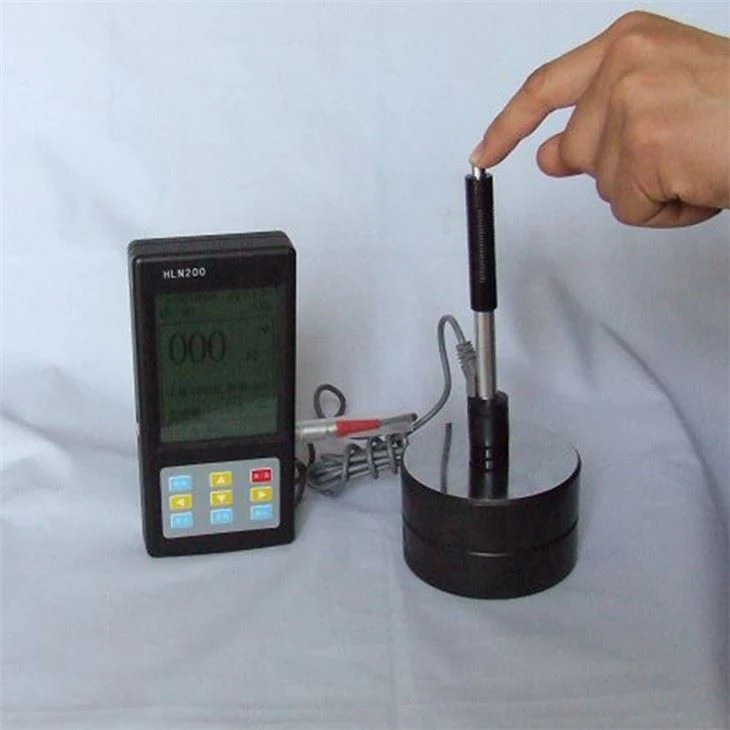
This method offers several advantages, such as portability, non - destructive testing (to a certain extent), and the ability to measure hardness on various shapes and sizes of specimens. Leeb hardness testers are widely used in industries like manufacturing, metalworking, and quality control for metals and alloys. For more information on rebound hardness testers, you can visit Rebound Hardness Tester.
Characteristics of Ceramics
Ceramics are a diverse group of materials that are typically composed of inorganic, non - metallic compounds. They are known for their high hardness, excellent wear resistance, high melting points, and good chemical stability. The hardness of ceramics is mainly determined by their crystal structure, chemical composition, and the presence of any defects or impurities.
The hardness of ceramics can vary significantly depending on the type of ceramic. For example, alumina ceramics have a hardness in the range of 1500 - 2000 HV (Vickers hardness), while silicon carbide ceramics can have a hardness as high as 2500 - 3000 HV. These values are much higher than those of most metals and alloys.
Can a Leeb Hardness Tester Measure the Hardness of Ceramics?
The answer to this question is both yes and no, and it depends on several factors.
Feasibility
- Surface Condition: Leeb hardness testing requires a relatively smooth and flat surface. Ceramics can be polished to meet this requirement. If the ceramic surface is properly prepared, the impact body of the Leeb hardness tester can make a valid impact, and the rebound velocity can be measured.
- Material Homogeneity: Ceramics are generally homogeneous materials at a macroscopic level. As long as there are no large - scale internal defects or inhomogeneities, the Leeb hardness testing method can potentially provide a reliable measurement of the average hardness of the ceramic material.
- Hardness Range: Some advanced Leeb hardness testers are designed to measure a wide range of hardness values. If the hardness of the ceramic falls within the measurement range of the tester, it is possible to obtain a hardness reading.
Limitations
- High Hardness: The extremely high hardness of many ceramics can pose a challenge for Leeb hardness testing. When the impact body strikes a very hard ceramic surface, it may not deform the ceramic material significantly, resulting in a very high rebound velocity. In some cases, the impact body may even bounce off the surface without leaving a visible indentation, which can lead to inaccurate or unreliable hardness measurements.
- Brittleness: Ceramics are brittle materials. The impact of the Leeb hardness tester's impact body may cause cracking or chipping on the ceramic surface, especially if the ceramic has pre - existing flaws or is under internal stress. This damage can not only affect the accuracy of the hardness measurement but also damage the test specimen.
Considerations for Measuring Ceramic Hardness with a Leeb Hardness Tester
If you decide to use a Leeb hardness tester to measure the hardness of ceramics, here are some important considerations:
- Impact Device Selection: Choose an appropriate impact device with a suitable impact energy. A lower impact energy may be more suitable for hard and brittle ceramics to reduce the risk of cracking or chipping.
- Surface Preparation: Ensure that the ceramic surface is clean, smooth, and flat. Any roughness or irregularities on the surface can affect the accuracy of the hardness measurement.
- Multiple Measurements: Take multiple measurements at different locations on the ceramic surface to obtain a more accurate average hardness value. This can help to account for any local variations in hardness or surface conditions.
- Calibration: Regularly calibrate the Leeb hardness tester using a standard hardness block. This is especially important when measuring materials with high hardness, such as ceramics.
Alternative Hardness Testing Methods for Ceramics
Given the limitations of Leeb hardness testing for ceramics, there are several alternative hardness testing methods that are more commonly used for ceramic materials:
- Vickers Hardness Testing: This method involves applying a known load to a diamond indenter in the shape of a square - based pyramid, which is pressed into the ceramic surface. The size of the indentation is measured, and the Vickers hardness value is calculated based on the applied load and the surface area of the indentation. Vickers hardness testing is widely used for ceramics because it can provide accurate hardness measurements for hard and brittle materials.
- Knoop Hardness Testing: Similar to Vickers hardness testing, Knoop hardness testing uses a diamond indenter, but the indenter has an elongated, rhombic shape. This method is particularly useful for measuring the hardness of thin ceramic films or coatings.
Conclusion
In conclusion, while it is possible to use a Leeb hardness tester to measure the hardness of ceramics under certain conditions, there are significant limitations due to the high hardness and brittleness of ceramics. However, with careful consideration of the impact device, surface preparation, and measurement techniques, it may be possible to obtain useful hardness data.
If you are in the market for a Portable Rebound Hardness Tester or Portable Hardness Tester for your hardness testing needs, whether for ceramics or other materials, we are here to assist you. Our team of experts can provide you with detailed information about our products and help you choose the most suitable hardness tester for your specific application. If you have any questions or would like to discuss a potential purchase, please feel free to reach out to us. We look forward to the opportunity to work with you and contribute to the success of your projects.
References
- Callister, W. D., & Rethwisch, D. G. (2011). Materials Science and Engineering: An Introduction. Wiley.
- ASTM E140 - 12. (2012). Standard Hardness Conversion Tables for Metals Relationship Among Brinell Hardness, Vickers Hardness, Rockwell Hardness, Superficial Hardness, Knoop Hardness, and Scleroscope Hardness. ASTM International.